New study finds comparable 18-month weight loss with oral and injectable semaglutide
New study finds comparable 18-month weight loss with oral and injectable semaglutide

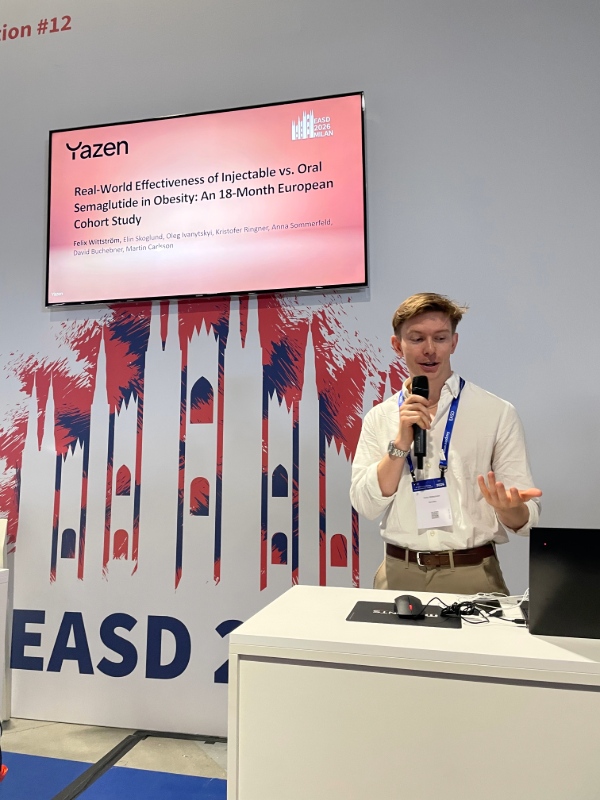
New real-world study finds comparable 18-month weight loss with oral and injectable semaglutide
Data from 16,940 adults receiving comprehensive digital obesity care show substantial and sustained weight loss with both formulations. At 18 months, mean body weight loss was 18.5% among patients who started injectable semaglutide and 18.0% among those who started oral semaglutide, with only a small adjusted difference between the groups.
Milan, 30 September 2026 - Yazen Health today presents new real-world evidence at the 62nd Annual Meeting of the European Association for the Study of Diabetes (EASD). The study compares the long-term effectiveness of injectable and oral semaglutide in adults with obesity treated through Yazen's multidisciplinary digital care model, where incretin-based therapy is combined with structured lifestyle support.
The retrospective cohort study included 16,940 patients across Europe who initiated injectable semaglutide (n=12,364) or oral semaglutide (n=4,576) between 1 January 2024 and 31 March 2026. It evaluated body weight, waist-to-height ratio and metabolic biomarkers over 18 months, while accounting for differences in age, sex, baseline BMI and diabetes status.
Substantial weight loss with both formulations
Patients in both cohorts achieved clinically relevant weight loss. Among patients contributing data at 18 months, mean body weight loss was 18.5% with injectable semaglutide and 18.0% with oral semaglutide. The adjusted difference was small at -0.41 percentage points (95% CI -0.78 to -0.06).
"These findings suggest that both injectable and oral semaglutide, as treatment options for obesity when used within multidisciplinary care. This means treatment choice can be tailored more closely to individual patients' needs and preferences", says Felix Wittström, MD at Yazen Health and presenting author of the study.
Beyond weight loss
The improvements extended beyond body weight. Both groups showed similar reductions in central adiposity, measured by waist-to-height ratio, as well as improvements in HbA1c and triglycerides. Adjusted differences between the cohorts were negligible for these secondary outcomes.
Treatment retention on any incretin therapy was 62.1% among patients who started injectable semaglutide and 60.8% among those who started oral semaglutide. At 18 months, mean doses were 0.85 mg weekly for injectable semaglutide and 13.4 mg daily for oral semaglutide.
Real-world evidence for personalised obesity care
Long-term comparative evidence for oral and injectable semaglutide in routine obesity care has been limited. The new analysis provides data from a large European population treated outside a randomised clinical trial and within a model that combines medication with continuous support from a multidisciplinary clinical team.
"Obesity is a chronic disease, and long-term treatment needs to work in everyday life. These results add important evidence that the route of administration does not have to determine the clinical outcome. Giving patients and clinicians more viable options may help us personalise treatment and support continuity over time," says Martin Carlsson, Associate Professor, Senior Physician in Endocrinology and co-founder of Yazen Health.
As an observational study, the analysis cannot establish that the two formulations are equivalent or prove causality. Weight and waist measurements were self-reported, and treatment switching, discontinuation and staggered enrolment reduced the number of patients contributing data at 18 months. The authors used adjusted longitudinal models to account for measured baseline differences and varying follow-up.
Read the full abstract
Read the full abstract here
Presentation at EASD 2026
Abstract title: Real-world effectiveness of injectable vs oral semaglutide in obesity: An 18-month European cohort study
Presenter: Felix Wittström, MD
Session: SO 069 What's really happening with glucose-lowering therapies?
Short Oral Discussion Event C, Station 12
Wednesday 30 September 2026, 11:45-12:45 CEST
Submission number: A-26-3058-EASD
Authors
Felix Wittström, Oliver Willacy, Elin Skoglund, Oleg Ivanytskyi, Kristofer Ringner, David Buchebner, Anna Sommerfeld and Martin Carlsson.
Flere nyheder


WOD26: Data afslører vedvarende skam og stigma omkring behandling af svær overvægt
Forud for World Obesity Day den 4. marts deler Yazen nye resultater fra interne patientdata, som viser, at skam og stigma fortsat er store barrierer for behandling af svær overvægt – selv i takt med at effektive medicinske behandlinger bliver mere tilgængelige.

Britiske virksomheder ser på fordelene ved GLP-1-behandling for at reducere sygefravær og øge præstationen.
Britiske arbejdsgivere overvejer i stigende grad vægttabsstøtte som en del af medarbejderfordelene, da nye data fra Yazen-patienter kobler GLP-1-behandling til færre sygedage og bedre præstation på arbejdspladsen.

Yazen opnåede rekordvækst i 2025 og fordoblet sin omsætning.
I 2025 steg Yazens omsætning med 87 % til næsten €29,4 millioner, mens bruttofortjenesten fordobledes til €16,5 millioner. Virksomheden behandler nu over 37.000 aktive patienter i syv lande og overvejer yderligere ekspansion til to nye markeder i 2026. På trods af en EBITDA på –€5,7 millioner som følge af store vækstinvesteringer er Yazen fortsat en førende aktør inden for behandling af svær overvægt i Europa.