Yazen Founder on the Lejonkulan Podcast: The Growth Journey and the Future of Obesity Care
Yazen Founder on the Lejonkulan Podcast: The Growth Journey and the Future of Obesity Care

Yazen Founder Magnus Nyhlén on the Lejonkulan Podcast: The Growth Journey and the Future of Obesity Care
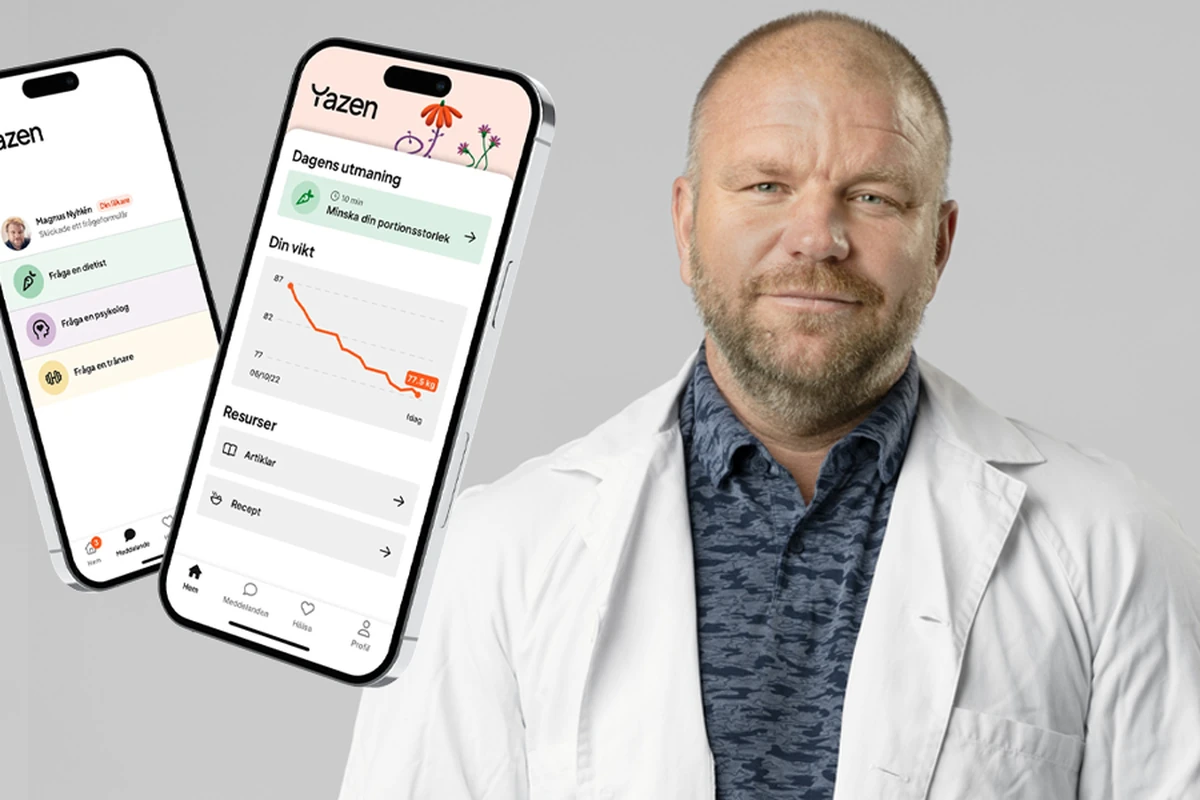
Yazen’s co-founder, Magnus Nyhlén, recently appeared on the business podcast Lejonkulan. In a conversation with investor Jan Dahlqvist, he shared insights on building a European healthcare provider for obesity, why medication can never stand alone, and why modern obesity care must be built on a long-term, holistic perspective.
Yazen was founded in 2021 by Magnus Nyhlén, MD and serial entrepreneur (co-founder of Min Doktor and Blodtrycksdoktorn), Martin Carlsson, associate professor and endocrinologist, Fredrik Meurling (CEO, former CEO/CFO of Min Doktor), and Otto Bretz (CTO, former co-founder of Min Doktor). While the company initially focused on male hormonal health, it pivoted to obesity care in 2022. This shift was driven by the founders' shared conviction that people living with obesity have long been underserved and neglected by traditional healthcare.
For Magnus, the issue is also deeply personal. On the podcast, he opened up about his own experience living with 35 kilos of excess weight. He described obesity as a condition that gradually limits life—from the struggle to tie your shoes to lacking the energy to play with your children or join in at football practice.
A Chronic Disease Requires a Complete Care Team
Yazen’s rapid growth has coincided with the major breakthrough of GLP-1 medications, such as semaglutide and tirzepatide. However, during the interview, Magnus was careful to emphasize that these treatments are not a quick fix. Obesity is a complex, chronic disease that requires lifelong management.
The success of the treatment is largely determined by the clinical support built around the medication. Today, Yazen treats over 47,000 patients through a network of around 130 doctors working closely with dietitians, nurses, psychologists, and physiotherapists. This multidisciplinary team is crucial for managing side effects, preserving muscle mass through proper exercise and protein intake, and supporting the psychological aspects of the disease.
Patient Retention as Proof of Effective Care
A central topic in the conversation was retention—how long patients stay in treatment. In the broader industry, most GLP-1 patients drop out of treatment quickly. Generally, only about 30 percent remain in treatment after twelve months, and for many digital providers, that figure is as low as 15–20 percent.
Yazen, on the other hand, shows vastly different clinical outcomes: approximately 70 percent of our patients remain in treatment after twelve months, and over 55 percent stay for more than three years.
“The explanation lies in the fact that Yazen treats obesity as a genuine chronic disease, rather than a transaction-based weight-loss product,” Magnus Nyhlén explained during the podcast.
By providing a dedicated doctor, a personal health coach, access to psychologists and physiotherapists, and a community platform, we create a sustainable support system. Furthermore, continuous lifestyle support enables the use of lower average doses of medication. This results in fewer side effects and lower costs for the patient—factors that significantly strengthen adherence over time.
Learnings from Scrutiny and the Path Forward
As a pioneer in digital obesity care, Yazen early on attracted attention from the Swedish Health and Social Care Inspectorate (IVO) and was featured in an episode of the investigative program Uppdrag granskning during 2024–2025. In the podcast, Magnus described how the company took the questions regarding internal medical record-keeping and patient-reported data with the utmost seriousness, leading to concrete improvements. Among other things, Yazen introduced a 3D-based body modeling system for safer and more accurate weight monitoring. After Yazen reported its measures, IVO confirmed that the changes successfully addressed the highlighted shortcomings.
Today, Yazen operates in Sweden, Norway, Denmark, the Netherlands, Germany, Spain, and Switzerland, with the Netherlands currently being the fastest-growing market. With an annual recurring revenue (ARR) of approximately 400 million SEK—representing a growth of around 250 percent over two years—the company is now seeking a Series B funding round of roughly €30 million to finance the next stage of its European expansion.
Looking three years ahead, the ambition is clear: Yazen aims to reach revenues in the billions (SEK) and hold a leading position across six major European markets. However, this growth will be built on the exact same principle that has brought us here: genuinely helping patients stay the course to achieve long-term health.
This article is based on an episode of the podcast Lejonkulan, hosted by investor Jan Dahlqvist and produced by Rapidus in collaboration with Ålandsbanken.